A look at what Ayurvedic daily wisdom and modern circadian science agree on: when we do a thing shapes what it does for us.
Wellness often begins not with a dramatic change, but with a simple daily ritual practiced consistently.

The Same Day, a Different Experience
Some mornings seem to unfold effortlessly. You wake a few minutes before the alarm, thoughts already clear. Hunger arrives naturally when it is time to eat, work feels manageable, conversations flow, and by evening you are pleasantly tired rather than completely depleted.
Other days feel entirely different, and strangely, nothing obvious has changed. You eat the same breakfast, drink the same coffee, and follow the same schedule, yet everything sits slightly out of tune. Energy dips arrive unannounced. Focus wanders. Sleep keeps its distance even though you are tired.
What changed?
Most wellness conversations focus on the what: what to eat, which supplement to take, what workout to follow. Those choices certainly matter and nutrition is a cornerstone of well-being — we have devoted whole essays to individual foods on this blog. Yet both ancient wellness traditions and modern scientific research keep pointing to a second question hiding inside the first: when are we doing these things?
Researchers studying circadian biology and chrononutrition continue exploring how the timing of sleep, meals, movement, light exposure, and daily behaviors may interact with overall well-being and physiological processes.6,7,4 This does not mean there is one perfect schedule for everyone. It suggests something less explicit and more interesting: that wellness may emerge not only from the individual choices we make, but from how those choices are arranged in time — how they repeat, and how they work together.
What the Oldest Traditions Knew About Rhythm
Long before wearable devices measured sleep or apps sent hydration reminders, people simply observed nature. The sun rose and set. Seasons turned. Plants followed cycles of growth and dormancy; animals migrated, hibernated, and adapted to recurring patterns. Human beings noticed that they, too, seemed to run on a schedule written somewhere deeper than habit.
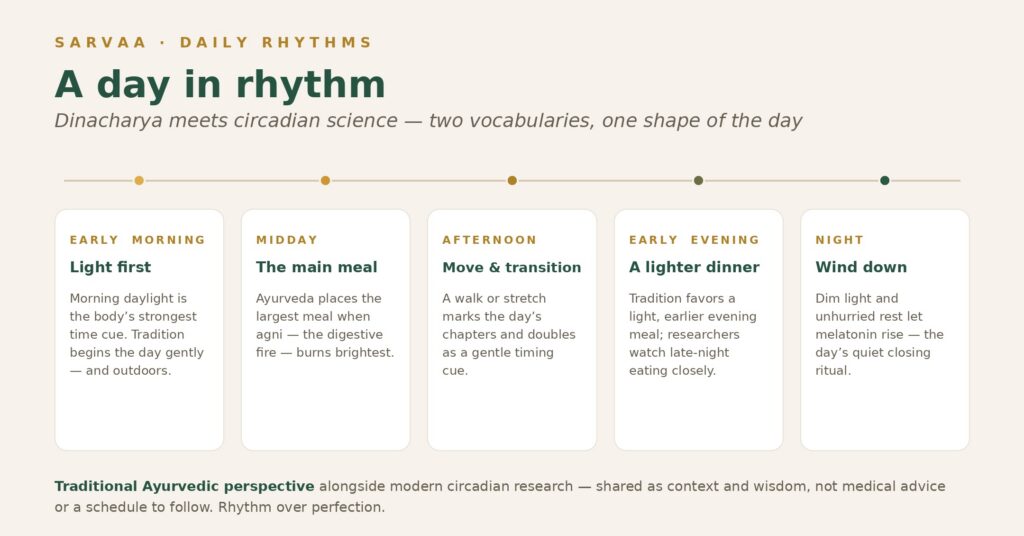
In Ayurveda, that observation matured into dinacharya — literally, the “conduct of the day” — a daily architecture designed to align individual habits with the natural progression of morning, midday, and evening. Tradition favored rising in the quiet hour before sunrise, taking in early light and gentle movement, and eating the day’s most substantial meal near midday, when the digestive fire the tradition calls agni was believed to burn brightest. Evenings leaned the other way: a lighter meal, softer activity, an unhurried descent toward sleep. Meals, movement, self-care, work, rest, and reflection were treated as interlocking parts of one larger pattern — not as isolated wellness activities to be optimized separately.
Whether one approaches Ayurveda as a philosophical system or as a historical wellness tradition, its message here is consistent: the shape of the day matters, and consistency is its own kind of nourishment. Modern whole-person health frameworks echo the idea. The National Center for Complementary and Integrative Health (NCCIH) describes health through a whole-person lens — physical, behavioral, psychological, social, and lifestyle influences understood as interconnected rather than separate.1,2
That perspective offers a useful reorientation. Wellness is rarely determined by one meal, one workout, or one difficult day. More often, it reflects the patterns we create again and again. Perhaps the more useful question is not “what is the perfect wellness practice?” but rather: “what patterns am I creating every day?”
Modern Science Has Its Own Language for Rhythm
In 2017, the Nobel Prize in Physiology or Medicine went to three scientists: Jeffrey C. Hall, Michael Rosbash, and Michael W. Young, who had isolated, in fruit flies, the molecular gears of a clock that ticks in nearly every living cell.9 Their work confirmed something tradition had intuited for millennia: rhythm is not a metaphor. It is biology.
Researchers call these cycles circadian rhythms; roughly 24-hour biological patterns that help coordinate sleep and waking, hormone activity such as cortisol and melatonin, digestion, body temperature, and metabolism.5,3,4 A master clock in the brain — a cluster of neurons sitting just behind the eyes — keeps this network loosely synchronized, and it takes its cues from the environment. Scientists call those cues zeitgebers, German for “time-givers.” Light is by far the strongest of them; sleep schedules, physical activity, and meal timing contribute as well.5,4
This changes how we might think about daily habits. Rather than isolated behaviors, they begin to look like signals — small messages sent to the body’s timing systems, telling them what hour it is and what to prepare for next.
Modern life, of course, complicates the conversation. Artificial lighting extends activity well past sunset. Work schedules vary. Meals drift from one day to the next, and digital connectivity blurs the boundaries between work, rest, and recreation. None of this is inherently negative — it is simply contemporary life. But it raises a frank question: if the human body evolved inside recurring daily cycles, how do modern habits speak to those internal clocks? Researchers are actively investigating exactly that.
Chrononutrition: When You Eat Joins What You Eat
Nutrition conversations usually begin on the plate — protein, fiber, vitamins, minerals, phytonutrients — and those subjects remain as important as ever. Increasingly, though, researchers are also studying the clock. A growing field called chrononutrition examines how eating behaviors interact with circadian rhythms: how consistent meals are from day to day, how long the daily eating window stretches, when meals land, and what happens when eating pushes late into the night.6,7,8
Some early findings are intriguing. In research highlighted by the National Heart, Lung, and Blood Institute, people who ate lunch later in the day lost less weight than earlier eaters on a comparable diet, and eating at night was associated with higher blood glucose responses.6 Recent reviews map similar territory, suggesting that mistimed eating — particularly late-night eating — may work against the body’s metabolic rhythms, while daytime-weighted, more consistent patterns appear to work with them.7,8
Two cautions keep this conversation honest. First, chrononutrition is an evolving field, and researchers themselves emphasize that many findings are preliminary and need larger trials. Second — and importantly — timing is not a replacement for nutritional quality. It is an additional variable that works alongside food quality, movement, sleep, and the rest of life.6,8
For most of us, the practical takeaway is refreshingly simple: become more aware. Notice when hunger arrives naturally. Observe when your energy feels strongest. Pay attention to whether meals feel rushed or intentional, and whether your eating schedule changes dramatically between weekdays and weekends. Awareness does not require perfection, it simply creates an opportunity to learn your own patterns.
Wellness Is Greater Than Food Alone
At Sarvaa, we believe nourishment matters deeply. But wellness cannot be reduced to food alone. Every meal exists within a broader ecosystem of sleep, movement, light, relationships, recovery, and purpose — and rhythm runs through all of it.
Sleep is where the day’s rhythm is either entrained or unwound. Researchers continue exploring how sleep quality, duration, and timing relate to overall health, and sleep remains among the processes most closely interwoven with circadian biology.3,4,5 When sleep becomes inconsistent, most other wellness habits get harder.
Movement serves purposes far beyond athletic performance. A short walk outdoors, a yoga session, gardening, stretching, or simply taking the stairs can become anchors in the day — transitions that mark one chapter ending and another beginning, and easy timing cues in their own right.
Light may be the most underrated wellness input of all. Daylight — especially early in the day — is the principal signal the body uses to distinguish day from night and keep its rhythms synchronized.5,4 A few unhurried minutes outdoors in the morning is both a biological signal and a small act of reconnection with the natural world.
Stress and recovery complete the picture. Modern culture prizes productivity, but sustainable wellness requires some balance from its opposite: rest. Reflection, prayer, mindfulness, meditation, journaling, breathing practices, and time in nature all create space to slow down. Whole-person approaches to health increasingly treat emotional, psychological, social, and spiritual well-being as core dimensions of health — not afterthoughts.1,10
The Power of Small Rituals
When people hear the word routine, they often picture a perfectly optimized schedule. Real life rarely works that way — and fortunately, wellness does not require it. It grows from simple rituals practiced consistently.
A ritual is different from a task. A task is something we complete. A ritual is something that shapes how we experience our day. A simple wellness ritual might include:
- Drinking a glass of water before reaching for your phone.
- Taking several slow breaths, or a few minutes of morning light, before the day begins.
- Enjoying a mindful cup of tea.
- Taking a brief walk outdoors after a meal.
- Eating without distraction whenever possible.
- Practicing gratitude before bed.
For some of us, the anchor is a morning glass: a spoonful of SuperFruit C stirred into water while the kettle warms, a Sita Protein smoothie after exercise, or a warm mug of Golden Bliss milk while winding down at night. The ingredients matter — that is why we formulate them the way we do — but part of the value lives in the pause itself: the same few minutes, the same small ceremony, quietly telling the body that the day has begun. As we wrote in our essays on amla and ashwagandha, the traditional rasayana was never one large dose. The repetition is the medicine.
A meaningful ritual is rarely dramatic. Its power lies in coming back to it, day after day, until it stops feeling like effort and starts feeling like home.

Rhythm Over Perfection
Modern wellness culture encourages us to search for the next breakthrough — the perfect food, the perfect supplement, the perfect routine, the perfect productivity system. Yet both ancient traditions and emerging science suggest another possibility. Instead of constantly asking what more we can add, we might occasionally ask:
- Am I creating time for rest?
- Am I noticing my natural energy patterns?
- Am I allowing space for recovery?
- Am I moving regularly — and getting outside?
- Am I approaching wellness with intention rather than urgency?
The answers will look different for every individual. Ayurvedic tradition described health as an ongoing relationship between people and the rhythms around them; modern circadian science explores many of the same themes through a different framework. Neither offers a one-size-fits-all prescription. Both encourage observation, awareness, and thoughtful experimentation.6,4,1
Because wellness often begins with a small adjustment. A new perspective. A moment of awareness. And sometimes the next step forward is not doing more — it is learning to move with the rhythms that were already there all along.
Key Takeaways
- Both Ayurvedic dinacharya and modern circadian science treat the day itself — its light, meals, movement, and rest — as a single connected pattern rather than a list of separate habits.
- Circadian rhythms are roughly 24-hour cycles that help coordinate sleep, hormones, digestion, temperature, and metabolism; light is their strongest cue, with activity and meal timing contributing.
- Chrononutrition — the study of when we eat — is young but promising; early research associates late-night and erratic eating with metabolic strain, while consistency and daytime-weighted eating appear supportive. Timing complements food quality; it never replaces it.
- Sleep, movement, morning light, and deliberate recovery are rhythm-keepers in their own right, and whole-person health frameworks treat them as core dimensions of well-being.
- Small rituals practiced consistently — a morning glass, a walk after lunch, a screens-down wind-down — do more over time than perfect routines followed briefly. Rhythm over perfection.
If holy basil and the nine superfruits were essays about what to bring into a daily practice, this one is about the practice itself. Explore the SuperFood Blog for the ingredient stories — and if you have found a daily ritual that works for you, write to us. We are always happy to hear how people build their days.
Sources Cited
1 National Center for Complementary and Integrative Health (NCCIH). “Whole Person Health: What It Is and Why It’s Important.” (Whole-person framing of interconnected physical, behavioral, psychological, and social influences on health.)
2 NCCIH. Supporting Research on the Whole Person (overview one-pager, 2025).
3 National Heart, Lung, and Blood Institute (NHLBI). National Center on Sleep Disorders Research. (NIH coordination of sleep and circadian biology research.)
4 National Institutes of Health (NIH). NIH Sleep Research Plan: Advancing the Science of Sleep and Circadian Research (2021).
5 Cleveland Clinic. “Circadian Rhythm: What It Is, How It Works & What Affects It.” (Overview of circadian regulation and environmental cues.)
6 NHLBI (2023). “Chrononutrition: Timing of Meals Matters for Your Health.” (Research news overview, including meal-timing and nighttime-eating findings.)
7 McHill, A. W., & Butler, M. P. (2024). “Eating Around the Clock: Circadian Rhythms of Eating and Metabolism.” Annual Review of Nutrition 44.
8 Peters, B., Vahlhaus, J., & Pivovarova-Ramich, O. (2024). “Meal timing and its role in obesity and associated diseases.” Frontiers in Endocrinology 15: 1359772.
9 The Nobel Assembly at Karolinska Institutet (2017). Press release: The Nobel Prize in Physiology or Medicine 2017 — discoveries of molecular mechanisms controlling the circadian rhythm (Hall, Rosbash, Young).
10 National Center for Health Statistics (2025). A Mixed-Method Evaluation of the Whole Person Health Index. (Nine measured dimensions of whole-person health, including stress management, sleep, and spirituality.)
Disclaimer
Insights are based on nutritional science, naturopathic principles, Ayurveda, and traditional herbal practice. Ingredient benefits reflect historical use and modern research on nutritional composition. Educational use only. This information is not medical advice and is not intended to diagnose, treat, cure, or prevent any disease. Statements have not been evaluated by the FDA. If you have a medical condition, work nights or rotating shifts, or are considering significant changes to your sleep or eating schedule, consult a knowledgeable healthcare professional.