
The Power of 4:3.
Do Less, Accomplish More
A simple way to change the rhythm and patterns of your week—and give more space to the things that nourish you.


We tend to imagine change as something dramatic. A new diet. A demanding exercise program. A complete morning routine. A list of things we are no longer going to eat, do, think, or feel. Monday arrives, and suddenly we are expected to become a different person.
But lasting change rarely happens because of one extraordinary Monday. More often, it happens gradually—because the routine of our ordinary days begins to shift.
We eat a nourishing breakfast a little more often. We walk after dinner instead of sitting down immediately. We go to bed on time more nights than we stay up too late. We make room for winding down instead of reaching for our phones. We choose whole food more frequently, take the stairs, drink the water, step outside, breathe, stretch, rest. Nothing hefty. Just a different rhythm.
Ayurveda Has Always Paid Attention to the Ordinary Day
And over time, that rhythm begins to point us in a different direction.
Ayurveda has a word for the intentional rhythm of daily life: dinacharya, often translated as “daily regimen” or “daily conduct.”[1,2]
The classical texts take the ordinary day remarkably seriously. In the Aṣṭāṅga Hṛdayam, an entire chapter walks through it from the pre-dawn hour onward: waking, cleansing, care of the senses, oil massage, exercise, bathing, and then — in the same breath — the conduct of a good life: speech, relationships, and habits of mind.[1] One detail is worth reflecting on. The text advises exercising to about half of one’s capacity, and warns plainly against overexertion.[1] Two thousand years before anyone coined the phrase “sustainable habit,” the tradition had already noticed that the practice you can repeat tomorrow is worth more than the one that leaves you depleted today.
Health becomes less about an occasional intervention and more about the way we live.
A similar philosophy appears in naturopathic practice. Among the profession’s six formal principles are prevention, education, attention to the whole person, and support for the conditions and behaviors that promote health. It focuses on the healing power of nature — which includes creating a healthy internal and external environment in which health can take hold.[3]
Different traditions use different language, but there is a useful idea shared among them: small things, practiced consistently, matter.
Modern Habit Science Gives Us Another Vocabulary
Modern behavioral science approaches the subject differently, but it also tells us something important about repetition.
In a well-known study of everyday habit formation, participants selected a simple eating, drinking, or activity behavior and repeated it in the same context—for example, after breakfast. As the behavior was repeated, it became increasingly automatic. Importantly, the time required varied considerably from person to person, and missing a single opportunity did not materially derail the habit-forming process.[4]
A later systematic review and meta-analysis reached a similarly useful conclusion: health habits often develop over a period of months, not according to a universal “21-day” rule, and the process varies widely among people and behaviors. Frequency, timing, personal choice, preparatory routines, and context can all influence habit strength.[5]
Consistency matters. Perfection does not.
The Power of 4:3
At Sarvaa, we like to think of 4:3 as a simple practice for changing direction. It is not an ancient Ayurvedic formula. Nor is four days a scientifically established biological “tipping point.” It is something much simpler:
In a seven-day week, give more days to the things you want more of than to the things you want less of.
Four and three: More often than not.
- If you want to move or exercise more, begin by doing so intentionally four days this week.
- If you want more whole foods in your life, build four days around meals rich in vegetables, fruits, whole grains, protein foods, healthy fats, herbs, and other nutrient-dense foods.
- If you want a calmer beginning to your day, give yourself four mornings without immediately reaching for a screen.
- If you want more restorative sleep, make four evenings the beginning of a bedtime routine.
- And if there is something you would like less of, reverse the equation: give it fewer days of your week.
The four days need not be consecutive, and they need not be the same four every week. Monday through Thursday is one natural shape; so is any four days that fit the life you actually have.
The power is not hidden somewhere in the number four. The power is in changing the balance.

The Power of 4:3 — four days establish direction;
three days leave room for life’s possibilities and happenstance.
Alt Text:
A seven-day week schedule shown on a wall above a table set with bountiful food. The text on the wall states “More of what nourishes” with “Monday thru Thursday” below it a little lower is the phrase “Room for life’s possibilities and happenstance,” with “Friday thru Sunday” under it. The picture illustrates the 4:3 practice.
Caption:
The Power of 4:3 — four days establish direction; three days leave room for life’s possibilities and happenstance.
Three days no longer becomes failure. Four days becomes direction.
Change the Tempo, and You Begin to Change the Pattern
Habits do not exist only inside our willpower. They are connected to places, times, routines, and cues.
Research on habit change describes how stable environments silently reinforce automatic behavior and how disrupting familiar cues, or deliberately creating new ones, can open a window for change. Behavioral scientists even speak of a habit's "architecture": the cues, contexts, and routines that hold it in place, and suggest that changing or creating that architecture can shape habits directly. Change the architecture, and the behavior often follows. [6]
A better question than “How can I make myself more disciplined?” may be:
“How can I make the practice I want a little easier to repeat?”
- Put your walking, hiking, or running shoes beside the door.
- Prepare tomorrow’s breakfast tonight.
- Leave a water bottle where you work.
- Place the book beside your bed.
- Schedule the walk. End the day with a plan for tomorrow.
- Turn the screens off a little earlier.
- Connect the new practice to something that already happens every day.
The aim is not to continually summon more willpower.
It is to create a rhythm that carries on.
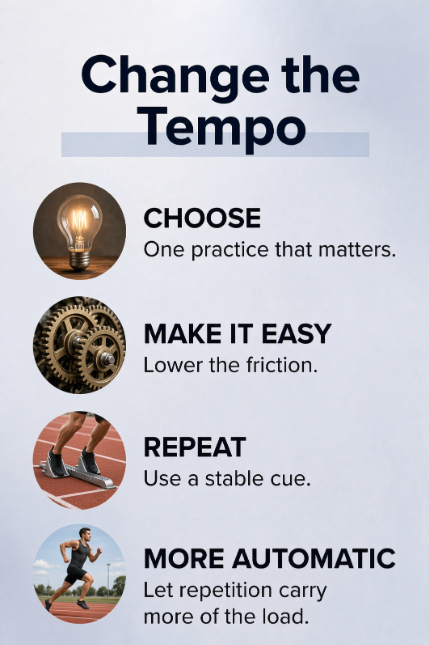
Do Less, Accomplish More
A phrase sometimes used in modern Vedic and Ayurvedic teaching is “Do less and accomplish more.” In that contemporary teaching context, the idea is not passivity. It is reducing unnecessary struggle and bringing our choices into better alignment with rhythms and practices that support us. It is working with the grain of the day rather than against it.[7]
That may be particularly useful in a wellness culture that often tells us that improvement requires adding more. More rules. More restrictions. More tracking. More intensity. More things to get right. Sometimes the healthier move is subtraction.
Do less of what repeatedly takes you away from where you want to go. Make a little more room for what brings you back. Then repeat.
Sometimes Adding Works Better Than Fighting
There is another intriguing lesson from behavioral nutrition research.
A systematic review and meta-analysis examining “implementation intentions”—specific plans for when and how a behavior will happen (“after I pour my coffee, I will eat a piece of fruit”) —found that these strategies were more effective at helping people increase healthy food choices than at helping them simply suppress unhealthy eating.[8] It is easier, it seems, to add a good thing than to argue with a bad one.
Instead of beginning with everything you need to stop, begin with what you want to make room for.
More nourishing meals prepared from whole foods. More water. More movement. More sleep. More time outside. More quiet. More connection. More of the practices that leave you feeling nourished rather than depleted.
As those things occupy more of the week, some of what you wanted less of may naturally begin to occupy less.

Wellness Is Bigger Than Any One Food—or Any One Supplement
Nutrition matters enormously. Current U.S. dietary guidance emphasizes eating patterns built around whole, nutrient-dense foods and recommends reducing highly processed foods, added sugars, and refined carbohydrates.[9]
But nourishment is only part of the picture.
Movement matters too—and it does not have to begin with an ambitious training plan. Public-health guidance recognizes that some physical activity is better than none and that weekly activity can be accumulated in smaller portions across the week.[10]
Sleep has its own rhythm. A 2025 systematic review found that day-to-day regularity in sleep and wake timing is increasingly recognized as a distinct dimension of sleep health, alongside sleep duration and quality.[11]
Contemporary lifestyle medicine brings these pieces together, emphasizing nutrition, regular physical activity, restorative sleep, stress management, positive social connection, and avoidance of risky substances as interconnected parts of whole-person health.[12]
This is also how we think about nutrition at Sarvaa. A food, botanical, or nutritional product does not replace a nourishing life. It belongs within one. Whole foods. Movement. Sleep. Rest. Connection. Purpose. And thoughtful nutritional support where it fits.
Not perfection. Balance.
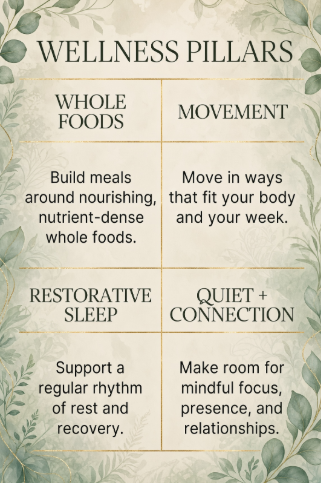
What Could Your 4:3 Look Like?
Maybe your 4:3 begins with breakfast. Four mornings this week, you make the more nourishing choice.
Perhaps it is movement. Four days, you take a 20-minute walk—even when you do not have time for the “real workout” you imagined you needed.
Maybe it is sleep. Four evenings, you begin winding down at a consistent time.
Maybe it is presence. Four mornings, you give yourself ten quiet minutes before email, news, and social media enter the day.
Or perhaps the shift is in what you want less of: less late-night snacking, less screen time, less sitting, less rushing, or less of a habit that has quietly begun taking more of your week than you intended to give it.
Choose one thing. Not ten. Give it four days. Then notice what happens. Build the New Instead of Fighting the Old
One of the hardest ways to change is to spend every day wrestling with the behavior we no longer want. Sometimes it is more useful to build something beside it.
- A walk where the sedentary hour used to be.
- Tea where the second sugary drink used to be.
- A nourishing snack prepared before hunger becomes urgent.
- A bedtime ritual where scrolling used to live.
- A pause where reaction once happened automatically.
Behavior researchers describe opportunities created when established cues and routines are disrupted, allowing new patterns to be intentionally built.[6] Sometimes the simplest way to change a habit is to change what happens around it. Our routines are often connected to familiar cues—the time of day, where we are, what we just finished doing, or what is sitting right in front of us. A small shift in that pattern can create just enough space to make a different choice. Move the phone out of reach. Put the walking shoes by the door. Prepare the nourishing snack before hunger hits. In that moment, we are not simply trying harder to resist the old habit—we are making the new one easier to choose. Disrupt the old pattern. Replace it with something better. Then repeat it often enough that the new rhythm begins to feel natural.[6]
You do not have to win a lifelong argument with the old behavior today. You can simply begin rehearsing the new one.
Four Days Forward. Three Days of Grace.
Perhaps the most important part of 4:3 is the three.
Those three days remind us that a balanced life has room for dinners with friends, unexpected schedules, travel, holidays, tired mornings, and evenings that simply do not go according to plan.
Research on habit formation offers some reassurance here: in the Lally study, one missed opportunity did not materially disrupt the habit-forming process. What mattered was returning to the behavior and continuing the repetition.[4] That is very different from the all-or-nothing thinking that so often surrounds wellness.
You did not “blow it.” The week is not ruined. Nothing needs to begin again next Monday. You simply return to the direction you chose.

A Better Direction, One Ordinary Week at a Time
We often overestimate what one perfect day can accomplish and underestimate the power of an ordinary practice repeated over time.
- Ayurveda reminds us to respect the rhythm of the day.[1,2]
- Naturopathic tradition reminds us to think in terms of prevention, education, and the whole person.[3]
- Nutrition reminds us to build our meals around nourishing, nutrient-dense whole foods.[9]
- Modern behavioral science reminds us that repetition and context matter—and that habits develop gradually.[4,5,6]
And 4:3 gives us a simple way to put those ideas into practice.
- Do less of what takes you away from the life you want.
- Make more room for what brings you toward it.
- Then allow the balance of your days to begin changing the direction of your life.
Four days forward. Three days of grace. And next week, continue in that direction.
Be Well,
Joshua and the Sarvaa Crew
Editorial Note on the 4:3 Framework
The “4:3” framework is presented in this draft as Sarvaa’s practical organizing concept, and not as a classical Ayurvedic rule or a scientifically validated threshold. The research cited supports the underlying ideas of repetition, stable cues, gradual habit formation, context, and consistency without perfection.
Disclaimer: This article is intended for educational purposes and is not a substitute for individualized medical or nutritional advice. Insights are based on nutritional science, naturopathic principles, Ayurveda, and traditional herbal practice. Ingredient benefits reflect historical use and modern research on nutritional composition. Educational use only. This information is not medical advice and is not intended to diagnose, treat, cure, or prevent any disease. Statements have not been evaluated by the FDA. If you have a medical condition, work nights or rotating shifts, or are considering significant changes to your sleep or eating schedule, consult a knowledgeable healthcare professional.
Sources & Research Notes
1 Vāgbhaṭa. Aṣṭāṅga Hṛdayam, Sūtrasthāna Chapter 2 — Dinacaryā Adhyāya (The Daily Regimen). Accessible translation and chapter overview at Satyori. Source link
2 Charak Samhita Research, Training and Development Centre, I.T.R.A. “Daily regimen for preservation of health (dinacharya).” Charak Samhita New Edition. Source link
3 Snider, P., & Zeff, J. (2019). “Unifying Principles of Naturopathic Medicine Origins and Definitions.” Integrative Medicine (Encinitas), 18(4), 36–39. Source link
4 Lally, P., van Jaarsveld, C. H. M., Potts, H. W. W., & Wardle, J. (2010). “How are habits formed: Modelling habit formation in the real world.” European Journal of Social Psychology, 40, 998–1009. Source link
5 Singh, B., Murphy, A., & Maher, C. (2024). “Time to Form a Habit: A Systematic Review and Meta-Analysis of Health Behaviour Habit Formation and Its Determinants.” Healthcare, 12(23), 2488. Source link
6 Verplanken, B., & Orbell, S. (2022). “Attitudes, Habits, and Behavior Change.” Annual Review of Psychology, 73, 327–352. Source link
7 Parris, A. (2024). “Foundations of Ayurveda.” Massage & Bodywork / ABMP. Used specifically for the contemporary Vedic framing of “Do less and accomplish more.” Source link
8 Adriaanse, M. A., Vinkers, C. D. W., de Ridder, D. T. D., Hox, J. J., & de Wit, J. B. F. (2011). “Do implementation intentions help to eat a healthy diet? A systematic review and meta-analysis of the empirical evidence.” Appetite, 56(1), 183–193. Source link
9 U.S. Department of Health and Human Services & U.S. Department of Agriculture. Dietary Guidelines for Americans, 2025–2030. 10th Edition (January 2026). Source link
10 Centers for Disease Control and Prevention. “Adult Activity: An Overview.” Physical Activity Basics. Source link
11 Kalkanis, A., Lenkens, D., Steiropoulos, P., & Testelmans, D. (2025). “Sleep regularity as an important component of sleep hygiene: a systematic review.” Sleep Medicine Reviews, 84, 102203. Source link
12 Grega, M. L., Shalz, J. T., Rosenfeld, R. M., et al. (2024). “American College of Lifestyle Medicine Expert Consensus Statement: Lifestyle Medicine for Optimal Outcomes in Primary Care.” American Journal of Lifestyle Medicine, 18(2), 269–293. Source link