
The Berry Behind The Legend
From Chinese herbals to the forests of the Russian Far East to a modern clinical trial: getting to know the berry behind the legend.
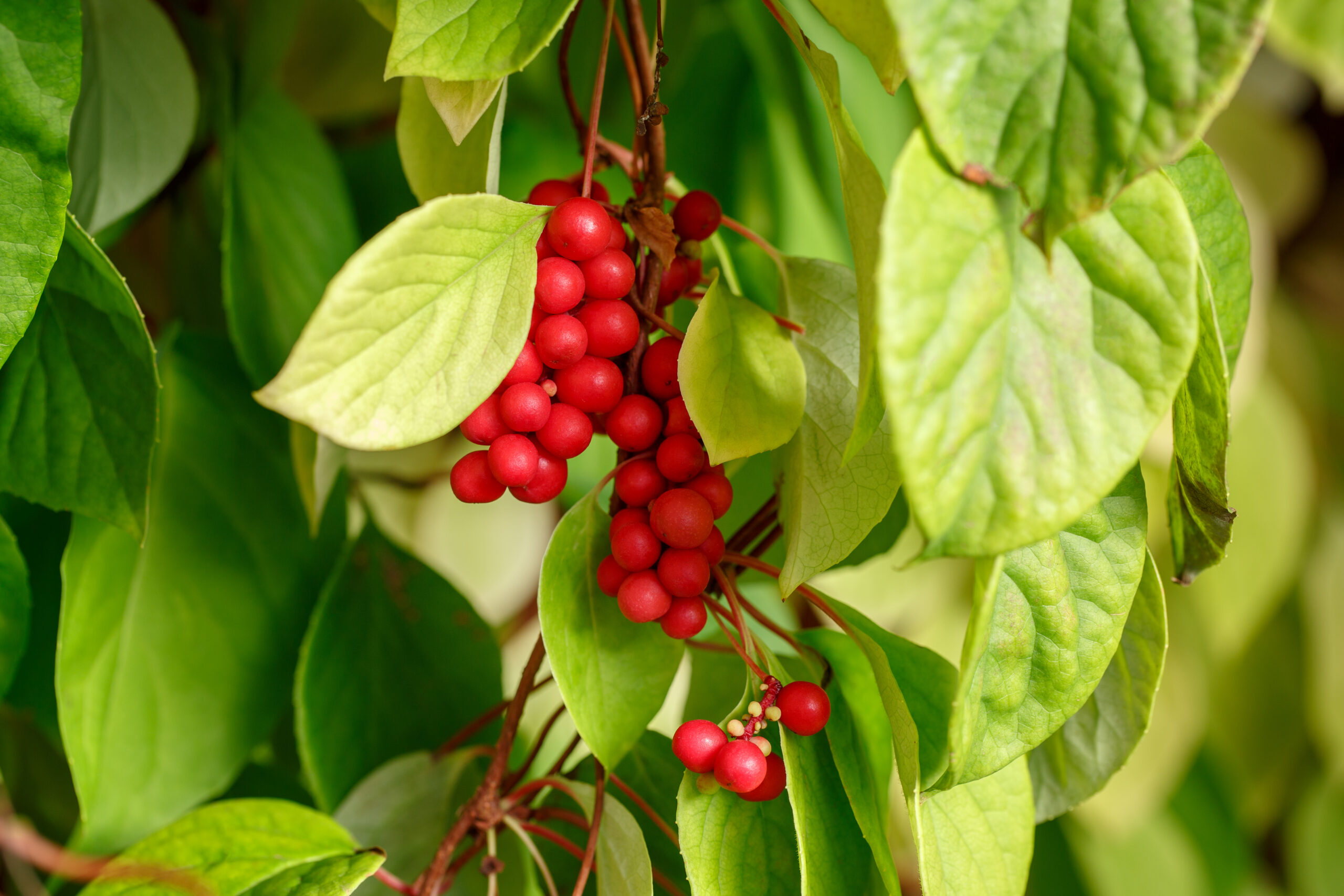
In Korea, one of the best-loved ways to meet this berry is in a glass. Omija hwachae is a rosy fruit punch made by soaking dried berries in cold water for hours, then straining and sweetening the pink liquid.1,2 Take a sip and the first impression is not subtle. Korea’s official government portal describes the berry’s “strong and sour taste,” the kind that “quenches the thirst.”1
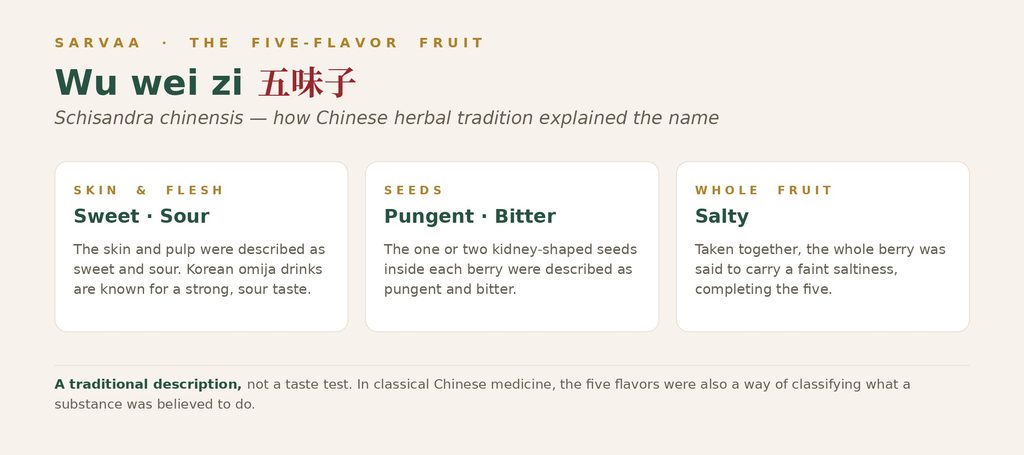
That makes its name a small puzzle. Omija, like the Chinese wu wei zi (五味子), means “five-flavor fruit”: sweet, sour, bitter, pungent, and salty, all attributed to a single red berry about a centimeter across. Many people who taste it notice one flavor, maybe two. So why did generations of herbalists insist on five?
Following that question leads somewhere surprisingly far: from classical Chinese medicine to Siberian hunting trails, Soviet military journals, and a 2021 clinical trial in South Korea. Along the way, Schisandra chinensis turns out to be one of the best teachers we know for a skill every curious eater needs: reading a botanical claim and knowing what it actually tells you.
A Name That Was Also a Map
Schisandra chinensis is a woody climbing vine of the cool, temperate forests of Northeast Asia, native from the Russian Far East through northern China and Korea to central Japan.3 Its plants are typically male or female, and in late summer the female vines hang with grape-like clusters, up to about 10 cm long, of bright red berries, each holding one or two kidney-shaped seeds.4
Chinese records of the medicinal berry reach back to the Eastern Han dynasty (25–220 CE).5 The traditional explanation of its name is anatomical: the skin and flesh are sweet and sour, the seeds pungent and bitter, and the fruit as a whole faintly salty.6 The name describes the entire fruit — skin, pulp, and seed — rather than the first impression of a single bite.
In classical Chinese medicine, though, flavor was never only about taste. The five flavors were a classification system, a vocabulary for describing what a substance was believed to do, with each flavor linked to an organ system.6 A berry that held all five was, in that worldview, unusually complete. China’s pharmacopoeia still describes the fruit in this traditional language, crediting it with “astringency” and “reinforcing qi (strength) to generate body fluids.”7 That is a description of a tradition’s framework, not a clinical finding. But it explains how one small berry earned an outsized reputation.
One more detail from the historical record matters later. For centuries, the name wuweizi covered two different plants: the northern Schisandra chinensis (bei wuweizi) and the southern Schisandra sphenanthera (nan wuweizi), and ancient texts often confused them.5,7 Today they are classified separately; they share their main compounds but in different amounts.8
Hunters, Explorers, and Soviet Field Journals
Russian scientists first wrote about schisandra in the forests of the Far East. In 1895 the Russian botanist Vladimir Komarov, and in 1903–1907 the explorer Vladimir Arsenyev, recorded how Nanai hunters of the Russian Far East used the berries as a tonic against thirst, hunger, and exhaustion, and to improve night vision.9 Traditional Russian medicine came to describe the fruit in similar terms, as a tonic that reduced hunger and fatigue.4
During the Second World War, that folk reputation became a research question. The first Soviet studies of schisandra’s stimulating and tonic effects appeared in military journals, and in the decades that followed researchers tested tinctures, seed powders, and an isolated compound, schisandrin, on sailors, pilots, students, and telegraph operators, usually measuring attention, accuracy, and working capacity under fatigue.9 The work helped shape a new idea. The Soviet toxicologist Nikolai Lazarev introduced the term “adaptogen,” and in the late 1960s Israel Brekhman and his colleague Dardymov developed it to describe substances thought to raise the body’s general resistance to stress.9 (For readers who want the full history, Panossian and Wikman’s 2008 review offers a detailed English-language overview.10)
Some of the findings are intriguing. In one study of 200 sailors on night duty, a schisandra tincture produced a tonic effect lasting four to seven hours. In the same study, two weeks of repeated use produced side effects much like those of repeated coffee: insomnia and excitability.9 That detail is worth remembering whenever a botanical is described as a stimulant without trade-offs.
It is just as important to know how strong that evidence is. In a 2010 review, Alexander Panossian and Georg Wikman, longtime adaptogen researchers, described the majority of the older clinical studies they compiled as “the most questionable and poorly documented,” noting missing randomization or blinding and assessment methods that differed from today’s standards.9 The Soviet record explains why scientists became interested. It does not, on its own, tell us what schisandra does.
Interest outlasted the Soviet era. By 2017, schisandra fruit had monographs in the Chinese, Japanese, Korean, and Russian pharmacopoeias, a World Health Organization monograph (2007), and a European Pharmacopoeia monograph (since 2008).4 A monograph sets standards for identity and quality. It is not a verdict on effectiveness.
From Flavor to Chemistry
Modern chemistry offers its own account of the five flavors. Much of the berry’s tartness comes from fruit acids, including citric, malic, tartaric, and fumaric acids.6 It also carries an essential oil, anthocyanin pigments that give it its red color, and polysaccharides.4,6 But the compounds that drew the most scientific attention are a family called dibenzocyclooctadiene lignans — schisandrin, schisandrin B, the gomisins, and their relatives — regarded as the most important constituents of the berries.4
Researchers have spent decades asking what these lignans do, investigating antioxidant, anti-inflammatory, liver-related, and nervous-system activity.11 The research is plentiful; the share conducted in people is small. A 2023 review of the berry’s cardiovascular potential noted that “many of these works are limited to in vitro models,” meaning cells in a dish.6 A 2025 meta-analysis pooled 54 studies of schisandra and liver injury, and every one was in mice or rats; the authors concluded that further research is needed to validate efficacy and safety.12
There is also the question of what actually reaches the body. A 2025 review of schisandra lignans highlighted “challenges in their absorption, distribution, metabolism and excretion, which impact their bioavailability.”11 The same lignans also interact with liver enzymes and transport proteins that handle many medications, a point that matters for safety.7
What the Human Research Actually Shows
The most informative modern human study is also a modest one. In a randomized, double-blind, placebo-controlled trial published in the American Journal of Clinical Nutrition in 2021, researchers at Pusan National University in South Korea gave 54 adults over age 50 with relatively low muscle mass either 1 gram a day of a Schisandra chinensis extract or a placebo for 12 weeks. Everyone was asked to walk 30 to 60 minutes a day, at least three days a week.13
By the end, the schisandra group had gained more knee-extensor strength than the placebo group, about 10 newton-meters on the right leg and 7 on the left. Muscle mass did not differ between the groups, and neither did markers of inflammation, antioxidant status, or quality of life.13 The authors’ conclusion is appropriately careful: the extract “may enhance skeletal muscle strength but not mass in older adults who perform low-intensity exercise.”13
That is a real finding and a narrow one: a single trial of one extract, at one dose, in one group of older adults who were also walking regularly. It says nothing about the berry brewed as tea or used as one ingredient among many. Memorial Sloan Kettering’s integrative medicine service summarizes the wider picture plainly: “Only a small number of studies have been conducted in humans and are too limited to draw any conclusions.”14 Many of the other human studies people cite tested combination products, such as formulas pairing schisandra with rhodiola and eleutherococcus, where schisandra’s own contribution cannot be separated out.9
Four Questions Worth Asking of Any Botanical
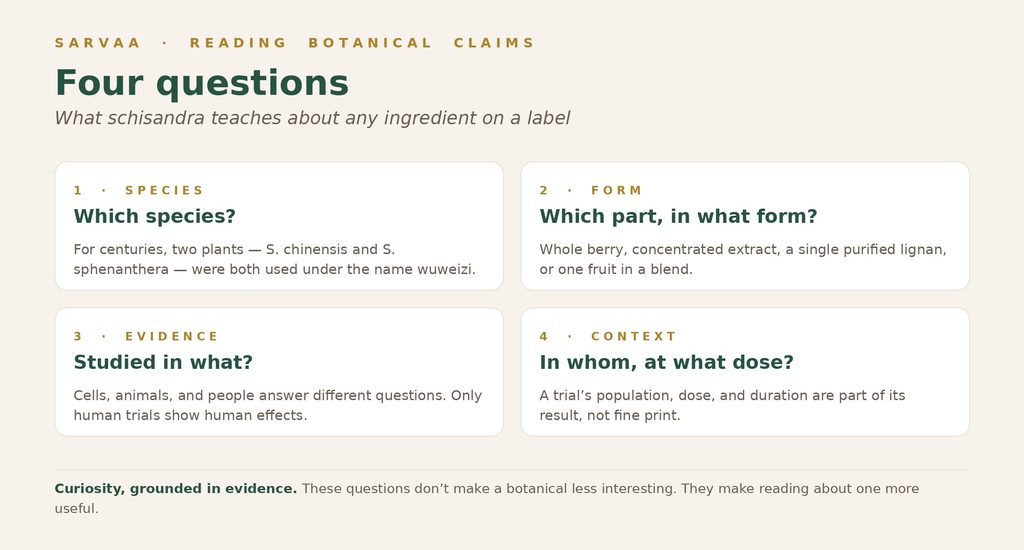
Schisandra makes an unusually good case study for reading ingredient claims, because almost every common confusion appears somewhere in its story. Four questions sort a great deal of signal from noise.
Which species? For most of its history, wuweizi meant two plants.5 Wuzhi capsule, a Chinese preparation studied alongside the transplant drug tacrolimus, is made from an extract of S. sphenanthera, not S. chinensis.15 Research on one species does not automatically transfer to the other.
Which part, and in what form? Whole dried berries, a concentrated extract, a single purified lignan, and a multi-ingredient blend are four different things. The 2021 trial used 1 gram of extract a day;13 a cup of omija tea or a spoonful of a fruit blend is a different exposure entirely.
Studied in what? Cells, animals, and people answer different questions. Fifty-four rodent studies12 do not add up to one human trial.
In whom, and at what dose? Older adults who walk several days a week13 are not necessarily a model for a 30-year-old trail runner, and a trial dose matters only if a product delivers something comparable.
None of these questions makes a botanical less interesting. They make curiosity more productive.
Tasting the Five Flavors Yourself
If schisandra’s story has you curious, the most direct way to meet it is the way much of East Asia does: as food. The Korean Food Promotion Institute’s recipe for omija hwachae soaks 60 grams of dried berries in cold water overnight, then strains the deep pink liquid and sweetens it with sugar and water.2 Taste it slowly and see how many of the five flavors you can find.
The same species, Schisandra chinensis, is also one of 13 organic fruits in Sarvaa’s Superfruit C, alongside acerola cherry, camu camu, rose hips, and amla berries. It is there as whole fruit within a broad spectrum of fruits, not as a concentrated extract, so the trial above does not describe what the blend does. The label suggests starting with 1 teaspoon a day for the first week and building gradually from there, and it mixes into water, juice, or a morning smoothie. To meet the other fruits in the blend, our guide to nine superfruits is a good place to start, and our post on amla berry tells the story of another fruit with a long traditional pedigree.

A Note on Safety
Schisandra has a long history as food and traditional medicine, and serious side effects have not been reported, but it has not been well studied in humans.14 The most important practical issue is medication interactions. Schisandra lignans can affect liver enzymes (particularly CYP3A) and a drug transporter (P-glycoprotein) that together process many common medications.7,14 In people, schisandra preparations have raised blood levels of drugs including tacrolimus, an anti-rejection medication, and midazolam, a sedative, and schisandra may alter the metabolism of warfarin.16 It can also lower liver enzyme values (ALT and AST) on blood tests, which could complicate their interpretation.14 Information on safety in pregnancy and breastfeeding is lacking.16 If you take prescription medications, are pregnant or nursing, have a medical condition, or have upcoming lab work, talk with your healthcare provider before adding schisandra or any concentrated botanical.
Key Takeaways
- The “five-flavor fruit” name comes from Chinese herbal tradition, where flavor described what a substance was believed to do, not just how it tasted.
- Accounts of Nanai hunters led to Soviet research that helped shape the “adaptogen” concept, though most of those studies would not meet today’s standards.
- The berry’s signature compounds are lignans, studied mostly in cells and animals.
- The best human trial to date found an extract improved strength, but not muscle mass, in older adults who walked regularly.
- Species, form, evidence, and dose all matter, and schisandra can interact with medications.
Five Flavors, Revisited
So does one berry really hold five flavors? Taste it, and you may find one or two. But the old name was never only a report on a first bite. It was a claim that the fruit was complex, that its skin, flesh, and seed each had something different to say. Modern science has arrived somewhere similar: schisandra is chemically rich, intriguing in the lab, and still largely unproven in people.
That is not a disappointing ending. It is an accurate one, and accuracy leaves room for the most useful kind of curiosity. The next time you see schisandra on a label, you’ll know to ask which species, which part, studied in what, and at what dose. And if you soak a handful of berries overnight, you’ll be tasting a fruit that hunters, herbalists, and scientists have been trying to understand for nearly two thousand years.
Be Well,
Joshua and the Sarvaa Crew
Disclaimer
Disclaimer: Insights are based on nutritional science, naturopathic principles, traditional Chinese medicine, Ayurvedic and other cultural traditions, and traditional herbal practice. Ingredient information reflects historical use and modern research on nutritional composition. Educational use only. This information is not medical advice and is not intended to diagnose, treat, cure, or prevent any disease. Statements have not been evaluated by the FDA. If you are pregnant, nursing, taking medication, or have a medical condition, consult a knowledgeable healthcare professional before adding new botanical foods or supplements to your routine.
Sources Cited
1 Korea.net (Yoon S., 8 July 2016). Article on omija hwachae.
3 Royal Botanic Gardens, Kew. Plants of the World Online: Schisandra chinensis (Turcz.) Baill.
14 Memorial Sloan Kettering Cancer Center. About Herbs: Schisandra (last updated 3 June 2022).
16 Drugs.com. Schisandra (Review of Natural Products monograph; last updated 3 July 2026).